Beta Cell Preservation
Impact of Beta Cell Preservation on Glycemic Control and Long-Term Complications
The clinical significance of preserving residual beta cell function (as measured by C-peptide) is established by decades of data. Even minimal secretion confers measurable protection.1-3 Population-based data from Finland4 confirm that a clinically meaningful proportion of individuals retain measurable residual secretion long after initial diagnosis, with protective effects persisting.4
The DCCT (1993–present) and EDIC analyses
The Diabetes Control and Complications Trial (DCCT) enrolled 1441 patients with type 1 diabetes (T1D) and established that intensive glycemic control reduces microvascular complications. Subanalyses of C-peptide data revealed an additional, independent protective effect of endogenous insulin secretion beyond glucose control alone.3,5
Among participants receiving intensive therapy, those with stimulated C-peptide ≥0.2 nmol/L experienced a 50% reduced risk of retinopathy progression and a 65% lower risk of severe hypoglycemia compared with nonresponders. Notably, intensive glycemic therapy itself was associated with a 57% reduction in the risk of becoming a C-peptide nonresponder (95% confidence interval [CI] 39%–71%, p < .001), establishing early glycemic optimization as a beta cell–preserving strategy.5
A subanalysis of the Diabetes Control and Complications Trial/Epidemiology of Diabetes Interventions and Complications (DDCT/EDIC) quantified the dose-response relationship between residual C-peptide and clinical benefit. For every 50% increase in stimulated C-peptide (eg, 0.10 → 0.15 nmol/L), participants experienced a reduction in hemoglobin (Hb) A1C of 0.07% (p = .0003), a reduction in daily insulin dose of 0.028 U/kg/day, an 8.2% reduction in hypoglycemia risk, and a 25% reduction in sustained retinopathy risk (p < .0001 for all). These data confirm that even incremental preservation of beta cell function translates into meaningful clinical benefit.3
Long-term follow-up of 944 DCCT/EDIC participants found that 12.4% retained measurable C-peptide even after decades of T1D. Those with high or intermediate C-peptide levels had a history of severe hypoglycemia in only 27% to 48% of cases, compared with 70% to 74% among nonsecretors (p for trend = .0001), a striking difference underscoring the lifelong protective value of even modest residual function.6
Finnish Nationwide Cohort4
In longitudinal and cross-sectional analyses of a nationwide Finnish T1D cohort, data confirmed that residual C-peptide is detectable across all T1D disease durations, including in individuals with more than 20 years of disease. It concluded that the preservation of C-peptide is independently associated with improved glycemic outcomes and reduced complication risk. This finding challenged the historical assumption that beta cell function is lost by time of diagnosis of T1D.4
Glycemic Control Benefits
The benefits of preserving residual C-peptide on day-to-day glycemic control are well-documented across multiple independent cohorts and study designs. The most granular dose-response data come from the DCCT/EDIC, in which researchers demonstrated a 0.07% reduction in HbA1C per 50% increase in stimulated C-peptide (p = .0003).3 A subsequent individual-participant meta-analysis by Taylor et al extended this finding, demonstrating that a 55% improvement in C-peptide preservation was associated with a 0.64% lower HbA1C (p < .0001).7
Beyond HbA1C, additional outcomes showed that higher urinary C-peptide:creatinine ratio was independently associated with significantly greater time in range (TIR), an effect that persisted even among patients using advanced diabetes technology including continuous glucose monitors (CGMs) and automated insulin delivery (AID) systems.8 Additionally, individuals with C-peptide of 30 to 200 pmol/L required 27% less basal insulin than those with C-peptide below 5 pmol/L.1 Residual C-peptide is also independently associated with reduced glycemic variability, lower coefficient of variation, and fewer glucose excursions above and below target range.1,2 A systematic review confirmed that residual beta cell function is associated with improved lipid profiles, reduced microalbuminuria, and superior overall metabolic control, independent of insulin regimen or device use.2

Tight Glycemic Control as a Beta Cell-Preserving Strategy9
A landmark 2023 randomized clinical trial provided the first prospective randomized controlled trial (RCT) evidence that intensive glycemic management in patients with newly diagnosed pediatric T1D actively preserves beta cell function, establishing tight glycemic control not merely as symptomatic management but as a disease-modifying intervention.9
The trial enrolled 113 children and adolescents (ages 7–17 years) with newly diagnosed T1D and randomized them to sensor-augmented pump therapy (tight control) versus standard care during the first year after diagnosis. The primary outcome was mixed-meal tolerance test (MMTT)-stimulated C-peptide area under the curve (AUC) at 12 months. Participants in the tight glycemic control group demonstrated significantly higher C-peptide AUC at 12 months compared with standard care (p = .006). The proposed mechanism is that reduced glucotoxicity from tighter glycemic control directly lowers metabolic stress on surviving beta cells, thereby slowing immune-mediated loss.9,10 Clinically, these data support early initiation of CGM and AID or sensor-augmented pump technology as a dual-purpose intervention, simultaneously improving glycemic control and preserving residual beta cell function, complementary to and independent of pharmacologic immunotherapy.
This trial supports the DCCT (1998) finding: Intensive glycemic therapy reduced the risk of becoming a C-peptide nonresponder by 57% (95% CI 39%–71%, p < .001).5,9,11

Hypoglycemia Risk Reduction
Hypoglycemia remains the most immediate and dangerous short-term consequence of insulin therapy in T1D. Residual C-peptide reduces this risk through multiple complementary mechanisms: It preserves counterregulatory glucagon responses via intra-islet insulin signaling, reduces glycemic excursions, and lessens reliance on precisely calibrated exogenous insulin dosing.1,2,6
The significance of rendered protection is substantial. In the DCCT, C-peptide responders experienced a 65% lower risk of severe hypoglycemia compared with nonresponders in the intensive therapy group (95% CI 53%–74%).5 Data from the Scottish T1D cohort showed an odds ratio (OR) of 0.56 (p = 6×10⁻⁸) for experiencing at least 1 serious hypoglycemic episode per year among patients with C-peptide 30 to 200 versus <5 pmol/L, and a hazard ratio of 0.52 (p = .03) for hospitalization for hypoglycemia.1 At 35-year EDIC follow-up, the rates of severe hypoglycemia history diverged markedly: 27% in the high C-peptide group versus 70% in nonsecretors (p = .0001).6 The Finnish nationwide cohort confirmed that this protective effect extends across all T1D durations, including in individuals who have lived with T1D for more than 20 years.4
Microvascular Complication Risk Reduction
In addition to hypoglycemia protection, residual C-peptide is associated with significantly lower rates of the microvascular complications of retinopathy and nephropathy. The protective mechanisms include direct vasoprotective and nephroprotective effects of C-peptide on endothelial and renal tubular cells.1,2 These are in addition to the established benefit of improved glycemic stability and reduced variability that reduce microvascular complications associated with T1D.5
The DCCT found a 50% reduced risk of retinopathy progression in C-peptide responders within the intensive treatment group.5 The findings of the Scottish cohort showed an OR of 0.55 (95% CI 0.34–0.89, p = .014) for retinopathy and an OR of 0.61 (95% CI 0.38–0.96, p = .033) for nephropathy with higher C-peptide levels, along with a hazard ratio of 0.44 (p = .0001) for diabetic ketoacidosis (DKA) hospitalization in those with C-peptide 30 to 200 versus <5 pmol/L.1 These findings are consistent with the systematic review by Lopes et al, which found independent associations between residual C-peptide and reduced microalbuminuria, lower cardiovascular risk markers, and better overall metabolic control.2
Summary: Why Beta Cell Preservation Matters
The C-peptide–outcome relationship is continuous and linear, not threshold-based. Even residual C-peptide levels confer clinically meaningful hypoglycemia protection.1,3 Partial preservation achieved through disease-modifying therapy is therefore clinically valuable across the full range of residual function.12,13
Intensive glycemic therapy itself preserves residual C-peptide: The DCCT demonstrated a 57% reduction in risk of becoming a nonresponder,5 a finding replicated in the RCT conducted by McVean and colleagues.9 Contrary to historical assumptions, it’s confirmed that residual beta cell function is more prevalent and clinically impactful in long-duration T1D than previously recognized and reinforces the relevance and importance of lifelong C-peptide monitoring.4
Assessment and Measurement of Beta Cell Function
The Role of C-Peptide as a Marker of Beta Cell Function
C-peptide is a 31-amino-acid byproduct of proinsulin cleavage, secreted in equimolar amounts to insulin but not cleared by the liver, making it the gold-standard biomarker of endogenous beta cell function in all insulin-treated patients.14,15 In addition to classification of diabetes, it may have an expanding role in precision diabetes care, guiding individualized treatment selection, therapy monitoring, and eligibility for novel disease-modifying interventions.16
C-peptide is produced in equimolar amounts to insulin during proinsulin processing in the pancreatic beta cells.14,15 Unlike insulin, it undergoes a negligible first-pass hepatic extraction, compared with approximately 50% clearance of insulin by the liver, giving it a half-life of 20 to 30 minutes versus 3 to 5 minutes for insulin, and causing it to circulate at approximately 5 times the plasma concentration of insulin.14,16 It is metabolized primarily by the kidneys, with approximately 5% to 10% excreted unchanged in the urine; levels therefore require interpretive adjustment in patients with chronic kidney disease (CKD), in which reduced renal clearance artificially elevates C-peptide concentrations and do not accurately reflect actual beta cell function.14,15 Importantly, C-peptide is absent from all therapeutic insulin preparations. Testing therefore is extremely useful in people who are receiving (or have received) insulin therapy.15,16
Direct measurement of insulin in insulin-treated patients is problematic due to several challenges: Insulin antibodies can interfere with immunoassays, and exogenous and endogenous insulin are immunologically indistinguishable in most assays.14,15,17 C-peptide immunoassays avoid these issues as they are not impacted by anti-insulin antibodies unless cross-reactivity with proinsulin produces falsely elevated results.14,15,17 However, clinicians should be aware that discrepancies of up to 38% have been documented between commercial C-peptide assay platforms, underscoring the need for standardized methodology (ie, using the same assay for each individual) when making treatment decisions based on threshold values.16,18,19
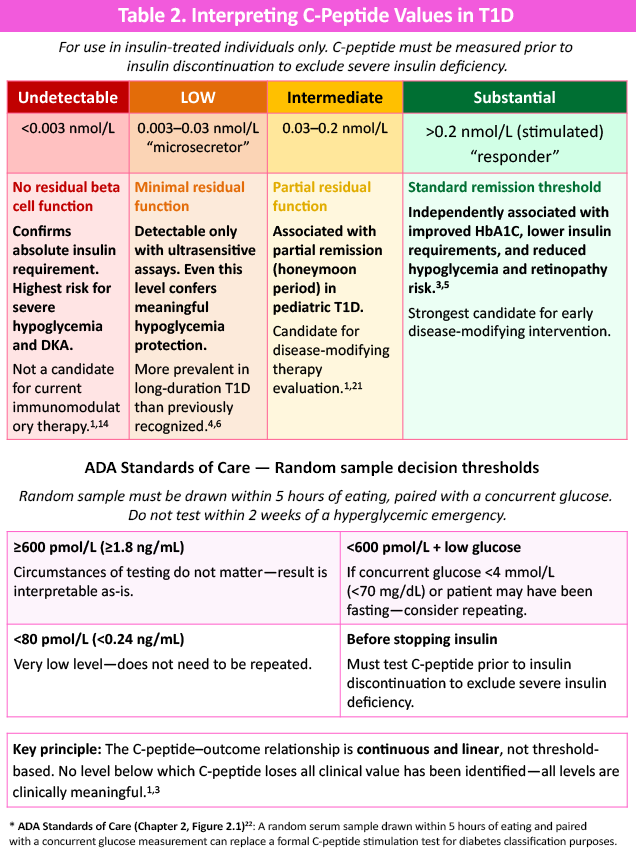
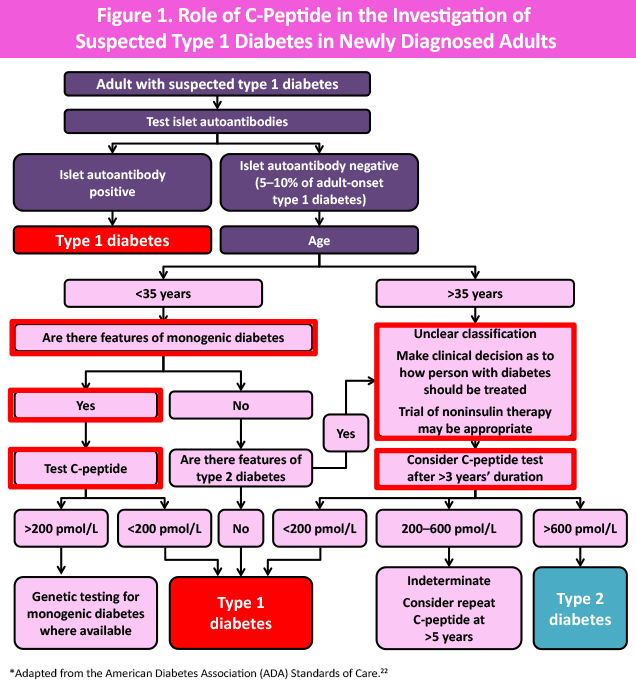
C-peptide measurement informs clinical decision-making at multiple levels. It is the primary tool for distinguishing absolute from relative insulin deficiency, which differentiates T1D from T2D, MODY, and other subtypes (as highlighted in figure below), as well as identifying candidates for disease-modifying therapies (since residual beta cell function must be present for current immunomodulatory agents to have a meaningful effect).12,14-16,20 Most major clinical trials with disease-modifying therapy in new-onset T1D use stimulated C-peptide as the primary endpoint.12,20 Beyond eligibility for treatments, C-peptide predicts risk of severe hypoglycemia, DKA hospitalization, and microvascular complications1,2,6; tracks disease progression and treatment response over time15,16; and defines partial remission (the honeymoon period) in pediatric T1D: stimulated C-peptide ≥0.2 nmol/L combined with insulin dose <0.5 U/kg/day and HbA1C <7%.21
How to Properly Measure and Interpret C-Peptide
Interpreting C-Peptide Values in T1D
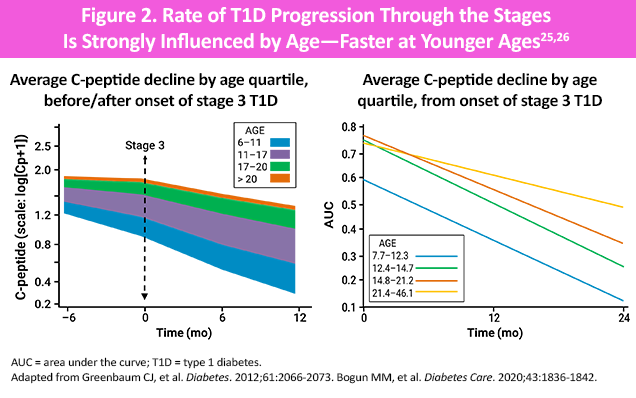
Rate of C-peptide decline varies considerably by age at diagnosis, with important clinical implications, as outlined int the figure below.21 Younger age at T1D onset is associated with more rapid and complete beta cell loss: Children diagnosed before 7 years of age progress more rapidly toward total C-peptide loss and have minimal beta cell retention compared with those diagnosed later.23 Conversely, adults diagnosed with T1D have greater frequency and higher values of C-peptide at all disease durations compared with those diagnosed in childhood. This finding was confirmed by Davis et al,24 who showed that in all duration of disease groups, the frequency of detectable C-peptide was higher among those diagnosed after age 18 years than at or before age 18 years. This means that the window for disease-modifying intervention is likely longer in adult-onset T1D, with implications for C-peptide monitoring frequency and the timing of therapeutic eligibility assessment.
In the pediatric population, research and clinical trials use the MMTT as the preferred measurement method.21 Partial clinical remission is defined by stimulated C-peptide ≥0.2 nmol/L combined with insulin dose-adjusted HbA1C.21 Earlier and more frequent C-peptide measurement is warranted when disease-modifying therapy or clinical trial enrollment is being considered, as the window of residual function is most clinically actionable in the first 1 to 2 years postdiagnosis.9,21
Measurement Standardization: A Persistent Clinical Challenge
C-peptide assay results remain nonstandardized across laboratories, creating a significant clinical challenge. There are documented discrepancies of up to 38% between current commercial assays and the international reference method.18 Hörber et al concluded that an international reference standard is urgently needed, particularly as disease-modifying therapies become available and rely on C-peptide thresholds for eligibility as well as response to treatment.17 The same patient can have different values depending on the laboratory and assay platform used.17,18 Clinicians must therefore use the same laboratory and assay platform for all serial C-peptide measurements in a given patient, interpret absolute thresholds with knowledge of the platform used, and be aware that international standardization via the World Health Organization (WHO) International Reference Reagent framework remains incomplete.16-19
Practical Measurement Considerations
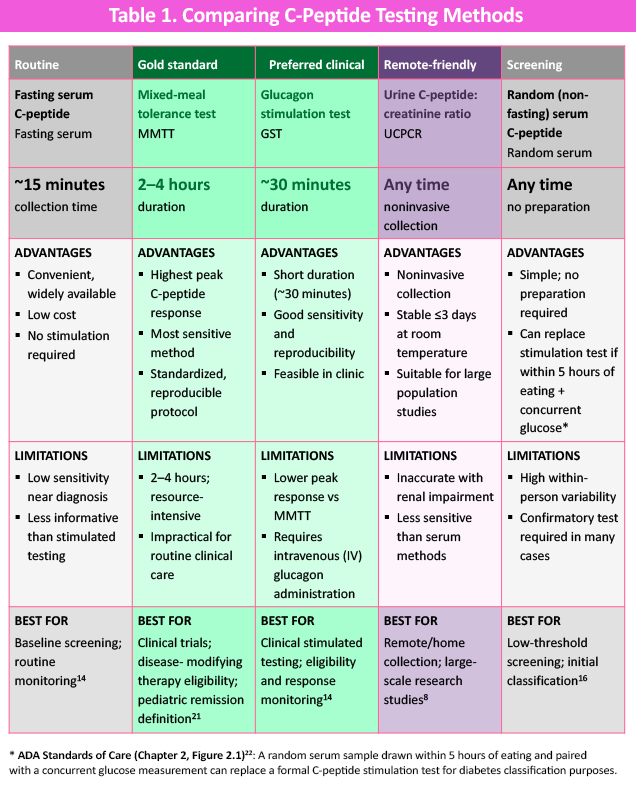
- For baseline assessment, C-peptide should be collected after a 4- to 8-hour fast. This is the most approachable technique in clinical practice (Table 1).
- Stimulated testing (MMTT or glucagon stimulation test [GST]) is preferred when precise quantification is needed for eligibility determination or therapy response monitoring.14,21
- Serial measurement every 3 to 6 months in the first 2 years after diagnosis is appropriate when disease-modifying therapy is being considered or monitored.11,21
- C-peptide should not be measured during acute illness or DKA, as stress hormones and severe hyperglycemia suppress secretion, and thereby produce artificially low results.
- In patients with CKD, reduced renal clearance artificially elevates C-peptide levels independent of beta cell function.14,16
- For individuals with long-duration T1D, ultrasensitive assays (detection limit 0.0015–0.0025 nmol/L) are required to detect residual secretion as it is confirmed that detectable C-peptide is more prevalent in this population than standard assays suggest.4,6
Current and Emerging Therapies for Beta Cell Preservation in T1D
The therapeutic landscape has expanded dramatically. T1D is now understood as an autoimmune disease with a prolonged preclinical phase offering multiple opportunities for intervention ranging from slowed progression of clinical onset through beta-cell preservation and potential cure.11,13,27,28
T1D Disease Staging Framework and the Presymptomatic Intervention Paradigm
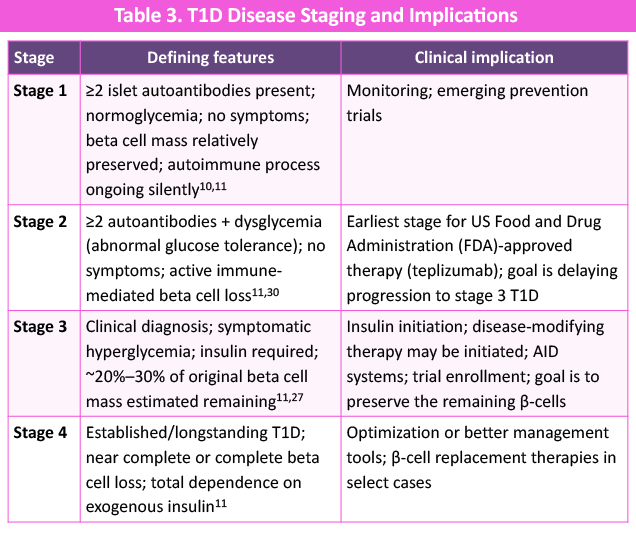
Therapeutic timing is guided by the staging model of T1D progression. Many argue that intervening before insulin is needed, at Stage 1 and 2, offers the greatest opportunity to protect beta cell mass and delay or prevent clinical T1D entirely.11 The goal in the early stages (stage 1 and stage 2) is to prevent progression to stage 3, and the approval of teplizumab to delay progression in patients with stage 2 T1D represents an important advancement, as outlined below.10 However, despite this remarkable success, there are still about 500,000 individuals who are diagnosed with stage 3 T1D each year, and they lack an approved treatment option other than insulin replacement.29 As such, additional options are needed to preserve β-cell function in new-onset stage 3. In longstanding T1D, or stage 4, the therapeutic goal is β-cell replacement or better management tools.
Disease-modifying therapies are most effective when initiated early; it was established that the autoimmune attack is most susceptible to modulation before the effector phase becomes self-sustaining.10 This was demonstrated with the TN-10 trial that led to the FDA approval of teplizumab to delay progression to stage 3 T1D in patients with stage 2 T1D, as outlined in a prior section of the DETECT-T1D website. However, there is a necessity for treatment options to preserve the remaining beta-cell function in new-onset stage 3 T1D, with several approaches in current development.
Among these options, teplizumab has demonstrated efficacy and safety in this setting as part of the published PROTECT trial and subanalyses as outlined below. In addition, the ongoing βETA PRESERVE trial is evaluating its efficacy and safety in this setting. Based on the results of the PROTECT trial, an expanded indication for new-onset (stage 3) T1D is currently under review by the FDA.
Teplizumab in New-Onset (Stage 3) T1D
PROTECT Trial: Phase 3 in Newly Diagnosed T1D (Stage 3)30
- Design: Phase 3, RCT; n = 328 children/adolescents ages 8 to 17 years, diagnosed within 6 weeks30
- Intervention: Two 12-day IV courses of teplizumab or placebo, 26 weeks apart30
- Primary endpoint: Change from baseline in MMTT-stimulated C-peptide at Week 7830
- Key result: Least-squares (LS) mean difference +0.13 pmol/mL (95% CI 0.09–0.17; P < .001)30
- C-peptide threshold: 94.9% teplizumab maintained peak C-peptide ≥0.2 pmol/mL vs 79.2% placebo30
- Integrated analysis across 5 trials (N = 609): C-peptide +0.08 nmol/L Year 1 (p < .0001), +0.12 nmol/L Year 2 (p<0.0001); insulin requirements reduced by 0.08 to 0.10 U/kg/day vs placebo31
- Secondary findings: Reduced risk of severe hypoglycemia; increased time in range (TIR); more participants met remission criteria; improved quality of life scores30,31
βETA PRESERVE Trial: Phase 3 in People With Stage 3 on Insulin Therapy32
- Design: Phase 3, RCT; n = children/adolescents/young adults ages 1 year to 25 years, diagnosed within 8 weeks (successor to PROTECT but extends to age 25 years)
- Intervention: IV course of teplizumab or placebo
- Primary endpoints (all are from baseline to Week 53): 1) Change in A1C from baseline; 2) Number of days not requiring prandial insulin; 3) Mean change from baseline MMTT-stimulated C-peptide in participants age 5 years and older
Safety Profile
- Most common adverse events: lymphopenia, rash, headache, diarrhea, vomiting, and leukopenia, which occurred primarily during/after the first treatment course and were generally self-limited.
- Cytokine release syndrome (CRS) warning is in the label, no evidence of long-term systemic immunosuppression across completed trials.
- Potential for viral reactivation, specifically EBV or CMV reactivation as listed in the label. Clinicians should test for active EBV or CMV infections before starting treatment.
Immunomodulatory Therapies in the Pipeline
The disease-modifying therapy pipeline is rapidly evolving. Specific agent names, trial results, and approval statuses are subject to change. They focus on common mechanisms such as altered antigen presentation, effector T-cell suppression, and reduction of inflammatory activity with the ultimate goal of delaying progression in early stages and preserving beta cell function in new-onset T1D. In addition to disease-modifying therapies, other approaches are ongoing, such as cell replacement therapies and virtual clinical trials and observational studies, with most studies in new-onset (stage 3) T1D, and a select few in earlier stages. Clinicians seeking the most current information for patient education and referral are encouraged to consult the resources below:
Clinical Trial Resources and Information
TrialNet – information on active research studies or clinical trials
Clinical trial information and status
Clinical Implementation: What Clinicians Need to Know Now
Translating the evidence on beta cell preservation into practice requires action across several domains
- Early Identification:
Screening individuals at risk for T1D, including first-degree relatives of those with T1D and anyone with a personal or family history of autoimmune disease, via TrialNet and other established programs is the critical first step. Early identification enables the implementation of maximally effective disease modification, as well as for patient education and preparation for what may lie ahead.11,33 C-peptide Measurement At and After Diagnosis
Timely measurement of C-peptide establishes therapeutic eligibility, remission status, and prognosis. Serial measurement every 3 to 6 months guides insulin dose adjustments and helps identify patients who may benefit from disease-modifying therapy or clinical trial enrollment.9,21 Early intensive glycemic management using sensor-augmented pump or AID therapy initiated at or near diagnosis is itself a disease-modifying strategy and should not be delayed pending other therapeutic decisions.9Offering Currently Available FDA-Approved Treatments
Currently, individuals ≥1 year of age who have stage 2 T1D are eligible for FDA-approved teplizumab therapy.
Referral to an endocrinology practice or infusion center with T1D disease-modification experience is essential for appropriate evaluation and administration.30,31 Newly diagnosed patients should also be referred to TrialNet and Breakthrough T1D clinical trial registries, where multiple trials across the T1D disease stage spectrum are actively enrolling.34,35Consistency and Accuracy Matter
Ongoing C-peptide monitoring should always use the same laboratory and assay platform for all serial measurements in each patient. Ultrasensitive assays should be used for individuals with long-duration T1D, and all results should be interpreted in the context of the platform’s reference range.4,17,18 When disease-modifying immunotherapy is under consideration, endocrinology coordination is essential; when cell replacement therapies are being evaluated, access to an established transplant program with relevant infrastructure is required.
References
- Jeyam A, Colhoun H, McGurnaghan S, Blackbourn L, McCrimmon R, McKnight J, et al. Clinical impact of residual C-peptide secretion in type 1 diabetes on glycemia and microvascular complications. Diabetes Care. 2021;44(2):390-398. https://doi.org/10.2337/dc20-0567
- Lopes V, Sousa ME, Lopes SC, Lages ADS. Metabolic impact of residual C-peptide secretion in type 1 diabetes mellitus. Arch Endocrinol Metab. 2024;68:e230503. https://doi.org/10.20945/2359-4292-2023-0503
- Lachin JM, McGee P, Palmer JP; DCCT/EDIC Research Group. Impact of C-peptide preservation on metabolic and clinical outcomes in the Diabetes Control and Complications Trial. Diabetes. 2014;63(2):739-748. https://doi.org/10.2337/db13-0881
- Harsunen M, Haukka J, Harjutsalo V, Mars N, Syreeni A, Härkönen T, et al. Residual insulin secretion in individuals with type 1 diabetes in Finland: longitudinal and cross-sectional analyses. Lancet Diabetes Endocrinol. 2023;11(7):465-473. https://doi.org/10.1016/S2213-8587(23)00123-7
- DCCT Research Group. Effect of intensive therapy on residual beta-cell function in patients with type 1 diabetes in the DCCT. Ann Intern Med. 1998;128(7):517-523. https://doi.org/10.7326/0003-4819-128-7-199804010-00001
- Gubitosi-Klug RA, Braffett BH, Hitt S, Arends V, Uschner D, Lachin JM, et al. Residual β cell function in long-term type 1 diabetes associates with reduced incidence of hypoglycemia. J Clin Invest. 2021;131(3):e143011. https://doi.org/10.1172/JCI143011
- Taylor P, Collins K, Lam A, et al. C-peptide and metabolic outcomes in trials of disease modifying therapy in new-onset type 1 diabetes: an individual participant meta-analysis. Lancet Diabetes Endocrinol. 2023;11:915-925. https://doi.org/10.1016/S2213-8587(23)00267-X
- Snethlage CMF, McDonald TJ, Oram RD, de Groen P, Rampanelli E, Schimmel AWM, et al. Residual β-cell function is associated with longer time in range in individuals with type 1 diabetes. Diabetes Care. 2024;47(7):1114-1121. https://doi.org/10.2337/dc23-0776
- McVean J, Forlenza GP, Beck RW, Ruedy KJ, Kollman C, Sherr JL, et al. Effect of tight glycemic control on pancreatic beta cell function in newly diagnosed pediatric type 1 diabetes: a randomized clinical trial. JAMA. 2023;329(12):980-989. https://doi.org/10.1001/jama.2023.2063
- Herold KC, Delong T, Perdigoto AL, Brusko TM, Gitelman SE, Gottlieb PA, et al. The immunology of type 1 diabetes. Nat Rev Immunol. 2024;24(7):435-451. https://doi.org/10.1038/s41577-023-00985-4
- Tatovic D, Narendran P, Dayan CM. A perspective on treating type 1 diabetes mellitus before insulin is needed. Nat Rev Endocrinol. 2023;19(7):361-370. https://doi.org/10.1038/s41574-023-00816-5
- Latres E, Greenbaum CJ, Oyaski ML, Battelino T, Buckingham B, Cuthbertson D, et al. Evidence for C-peptide as a validated surrogate to predict clinical benefits in trials of disease-modifying therapies for type 1 diabetes. Diabetes. 2024;73(6):823-833. https://doi.org/10.2337/dbi23-0012
- Nagy G, Szekely TE, Somogyi A, Herold M, Herold Z. New therapeutic approaches for type 1 diabetes: disease-modifying therapies. World J Diabetes. 2022;13(10):835-850. https://doi.org/10.4239/wjd.v13.i10.835
- Jones AG, Hattersley AT. The clinical utility of C-peptide measurement in the care of patients with diabetes. Diabet Med. 2013;30(7):803-817. https://doi.org/10.1111/dme.12159
- Maddaloni E, Bolli GB, Frier BM, Little RR, Leslie RD, Pozzilli P, et al. C-peptide determination in the diagnosis of type of diabetes and its management: a clinical perspective. Diabetes Obes Metab. 2022;24(10):1912-1926. –———–